
It usually starts small. You spit after brushing and the foam is pink. Or you bite into an apple and leave a faint red mark behind. If you are searching for bleeding gums in Scarborough because this keeps happening, you are not alone — and you are right not to ignore it. Healthy gums do not bleed during gentle brushing or flossing. Bleeding is an early warning sign, and the good news is that the earliest stage of gum disease is the one stage that can be fully reversed.
This guide explains, in plain language, why gums bleed, the difference between gingivitis and periodontitis, what gum treatment at AF Dental actually involves, and the home habits that genuinely help. If you want the service picture first, read about gum care at AF Dental, then come back here for the symptom guide.
On this page:
- Why Gums Bleed: Plaque, Gingivitis, and What Changes as It Progresses
- Bleeding That Is Not Gum Disease
- Gingivitis vs Periodontitis, in Plain Language
- What Gum Treatment at AF Dental Looks Like
- Receding Gums and Grafting: When That Conversation Starts
- Home Care That Genuinely Helps (and What to Stop Doing)
- Coverage, Honestly: CDCP, Insurance and Quotes
- References
- Frequently Asked Questions About Bleeding Gums
Why Gums Bleed: Plaque, Gingivitis, and What Changes as It Progresses
The most common cause of bleeding gums is plaque — the soft, sticky film of bacteria that builds up on teeth every day, especially along the gumline. When plaque is not removed thoroughly, it hardens into tartar (calculus), and the bacteria in it irritate the gum tissue. The gums respond the way irritated tissue responds anywhere: they become red, slightly swollen, and tender, and they bleed easily when brushed or flossed. That early inflammation is called gingivitis.
Gingivitis itself does not damage the bone that holds your teeth. But left alone, the inflammation can move deeper. The gum pulls slightly away from the tooth, forming a pocket that traps more plaque where a toothbrush cannot reach. Bacteria and tartar collect below the gumline, the pocket deepens, and over time the supporting bone begins to shrink back. That deeper stage is periodontitis, and unlike gingivitis, the bone loss it causes cannot be grown back — it can only be stopped and managed. This is why a symptom that looks minor, like bleeding gums in Scarborough patients who otherwise feel fine, deserves an assessment rather than a wait-and-see approach: the window where everything is reversible is exactly the window where nothing hurts.
Bleeding That Is Not Gum Disease
Not every case of bleeding gums is gum disease, and a proper assessment considers the other causes too:
- Brushing too hard, or with a hard-bristled brush. Scrubbing traumatizes the tissue. A soft brush and gentle pressure clean just as well.
- A new flossing routine. Gums that have not been flossed in a while often bleed for the first several days, then settle as the inflammation clears. Bleeding that continues beyond about a week of gentle daily flossing is the kind that needs an assessment.
- Medications. Blood thinners and some other medications make bleeding more likely and slower to stop. Always tell your dental team what you take.
- Pregnancy. Hormonal changes can make gums react more strongly to plaque, a pattern sometimes called pregnancy gingivitis. It still needs plaque control and monitoring, not dismissal.
- Other health conditions. Conditions such as diabetes are associated with gum problems in both directions, and occasionally persistent bleeding points to something beyond the mouth that a medical assessment should check. Your dentist will say so plainly if that is a concern.
Gingivitis vs Periodontitis, in Plain Language
Gingivitis is inflammation of the gum surface only: redness, swelling, bleeding on brushing or flossing, sometimes bad breath. There is no bone loss yet, and with thorough plaque removal — professional cleaning plus consistent home care — the gums can return to health completely.
Periodontitis is what gingivitis can become when the inflammation reaches the structures that hold the tooth: the ligament and the bone. Pockets form and deepen, gums may recede, teeth can feel slightly loose or drift, and bad breath often persists. Periodontitis is a chronic condition that is managed, not cured — treatment aims to remove the bacterial deposits below the gumline, shrink the pockets, and hold the disease stable with regular maintenance visits. Teeth that might have been lost to untreated periodontitis are commonly kept for years when the condition is treated and maintained.
What Gum Treatment at AF Dental Looks Like
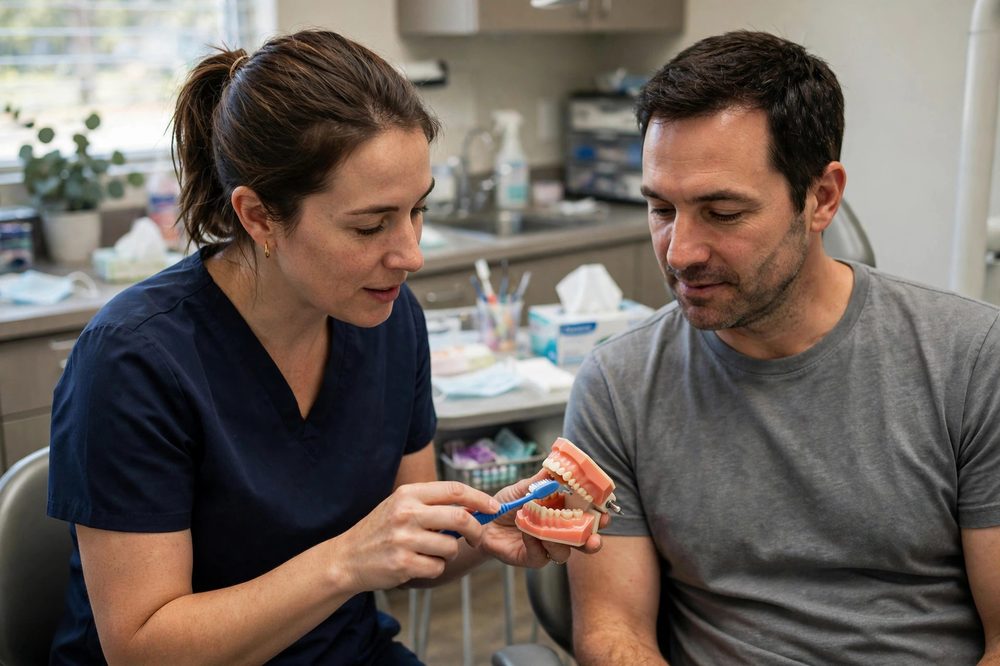
Treatment starts with measurement, not instruments. At an assessment, the gum pockets around each tooth are gently measured, X-rays show the bone levels, and the amount of plaque and tartar is recorded. That picture decides what happens next:
- For gingivitis: a professional cleaning to remove plaque and tartar above and at the gumline, plus a home-care plan you can actually sustain. Many patients fold this into their regular dental cleanings and oral hygiene visits.
- For periodontitis: deeper cleaning below the gumline, called scaling and root planing, usually done in sections with local anaesthetic so the area is numb while the deposits are removed and the root surfaces are smoothed. Afterwards, pocket depths are re-measured to confirm the gums have tightened, and a maintenance schedule — often every three to four months rather than six — is set, because periodontitis returns quickly without it.
- For advanced cases: if pockets are too deep to clean non-surgically, or bone defects need direct attention, that is discussed honestly, including referral to a gum specialist where that is the right step. AF Dental’s dentists are general dentists; complex surgical cases are referred rather than improvised.
You can book an appointment for a gum assessment during business hours.
Receding Gums and Grafting: When That Conversation Starts
Recession — gums pulling back so teeth look longer and roots show — can come from periodontitis, from years of hard brushing, from tooth position, or a combination. Exposed roots can be sensitive and are more vulnerable to decay. Not every receded area needs a graft; many are simply monitored with careful measurements at each visit. The grafting conversation starts when recession is progressing, when sensitivity or root decay becomes a problem, or when the remaining gum tissue is too thin to protect the tooth. You can read about the procedure itself on our gum and bone grafting page.
Home Care That Genuinely Helps (and What to Stop Doing)
- Brush twice a day with a soft brush, angled at the gumline, with gentle pressure. If the bristles splay out within a month or two, you are pressing too hard.
- Clean between your teeth daily — floss or interdental brushes. This is the step that reaches the exact spot where gingivitis starts. Bleeding during the first week usually means the gums need this, not that you should stop.
- Do not stop flossing because of bleeding. Stopping removes the one thing that clears the plaque causing the inflammation, so the bleeding returns worse the next time you try.
- Skip the harsh routines: very hard brushes, aggressive scrubbing, and strong antiseptic rinses used as a substitute for mechanical cleaning. A rinse can support a routine; it cannot replace one.
- If you smoke, know the trap: smoking reduces gum bleeding by restricting blood flow, so gums can look deceptively quiet while disease progresses underneath. Smokers should not use absence of bleeding as reassurance.
Coverage, Honestly: CDCP, Insurance and Quotes
For eligible patients, the Canadian Dental Care Plan (CDCP) covers preventive and gum-related services, including examinations and scaling, according to the CDCP fee guide. Eligibility always comes first: the plan is for Canadian residents without access to dental insurance whose adjusted family net income is under $90,000, and what the plan pays is a percentage set by its fee guide — it is not automatically the full amount of a clinic’s regular fee. AF Dental participates in the CDCP and direct-bills it, and the full picture is on our Canadian Dental Care Plan page. Private insurance plans commonly include scaling and periodontal maintenance benefits, each with its own limits. This page carries no prices, because treatment is planned from your own measurements: after an assessment, you receive an exact written quote before any treatment begins. Call AF Dental in Scarborough at (416) 792-6940 during business hours to book a gum assessment.
References
- Canadian Dental Association — gum disease information for patients: cda-adc.ca
- Ontario Dental Association — patient oral health resources: oda.ca
- Government of Canada — Canadian Dental Care Plan (what services are covered): canada.ca
- Royal College of Dental Surgeons of Ontario — public register and patient resources: rcdso.org
Frequently Asked Questions About Bleeding Gums
Should I stop flossing if my gums bleed?
No — keep flossing, gently. In most cases the bleeding is caused by the plaque sitting between the teeth, and flossing is what removes it. Expect some bleeding for the first several days of a new daily routine; as the inflammation clears, it should lessen and stop. If bleeding continues after about a week of gentle daily flossing and careful brushing, book an assessment — persistent bleeding is the signal that plaque below the gumline or tartar needs professional removal.
Can gum disease be reversed?
Gingivitis, the early stage, can be reversed completely: remove the plaque and tartar, keep up daily cleaning between the teeth, and the gums return to health. Periodontitis, the deeper stage involving bone, cannot be reversed — the bone that has been lost does not grow back — but it can be treated and held stable, often for many years, with deep cleaning followed by regular maintenance visits. That difference is the strongest argument for acting while the only symptom is bleeding.
Is gum disease connected to the rest of my health?
Research has found associations between periodontitis and conditions such as diabetes and cardiovascular disease — people with one are more likely to have the other — and diabetes that is poorly controlled tends to make gum disease worse, while gum inflammation can make blood sugar harder to manage. Association is not the same as proof that one causes the other, and treating your gums is not a substitute for medical care. It is one more reason dentists and physicians both take gum health seriously, and why your dental team asks about your overall health and medications.
Does the CDCP cover gum treatment?
For eligible patients, yes — the Canadian Dental Care Plan covers services such as examinations, cleanings and scaling according to its fee guide. Eligibility comes first: you must be a Canadian resident without access to dental insurance, with an adjusted family net income under $90,000. Coverage is a percentage set by the CDCP fee guide, not automatically the clinic’s full fee, and AF Dental direct-bills the CDCP so eligible patients know their share before treatment. More detail is on our CDCP page, linked above.
My gums only bleed sometimes. Can it wait until my next check-up?
If the bleeding is new and your next check-up is soon, mention it at that visit and step up your between-teeth cleaning in the meantime. Book sooner rather than waiting if the bleeding happens most days, if it has lasted more than about a week despite gentle daily flossing, if you notice swelling, persistent bad breath, receding gums, or a tooth that feels different or loose — or if you are pregnant or take blood thinners, where an earlier look is simply prudent.
What is scaling and root planing, and will it hurt?
Scaling removes plaque and hardened tartar from the tooth surfaces, including below the gumline; root planing smooths the root surfaces so the gum can reattach more closely and plaque is harder to cling to. The area is numbed with local anaesthetic first, so the appointment itself is managed in the same way as other routine dental treatment. Some tenderness and sensitivity for a few days afterwards is common and usually settles with normal home care; your team will tell you what to expect for your case.
Can receding gums grow back on their own?
No — gum tissue that has receded does not grow back by itself, which is why the first goal is to find and stop the cause: disease, brushing pressure, or both. Mild, stable recession is often simply measured and monitored at each visit. When recession is progressing, or the exposed root becomes sensitive or decay-prone, grafting may be discussed as a way to cover and protect the area. An assessment will tell you honestly which situation you are in.
How do I know if my bleeding gums are an emergency?
Ordinary gum bleeding is a book-an-appointment problem, not an emergency. Seek care the same day during business hours if bleeding will not stop, if you have facial swelling, a fever, a bad taste with swelling along the gum, or pain you cannot manage — and if severe swelling affects swallowing or breathing after hours, go to an emergency department or call 911. AF Dental sees patients during business hours (closed Tuesdays); we do not offer an after-hours service.