
It is one of the hardest conversations in dentistry. You have a tooth that is badly damaged, deeply decayed, or infected, and you are told there are really two directions left: try to save it with root canal treatment, or have it removed. Patients searching for root canal treatment scarborough options are usually sitting exactly at that fork — and what they need is not a sales pitch for either side, but an honest explanation of how the decision is actually made.
This guide gives you that explanation. It covers what a root canal actually does, the signs that a tooth can usually be saved, the situations where removal is the honest recommendation, what happens after an extraction if the space is left empty, and how your dentist weighs it all up at your assessment. No decision about a specific tooth can be made from symptoms alone: it is made from an examination and X-rays of that tooth. If you want the service picture first, read about root canal therapy at AF Dental, then come back here for the decision guide.
On this page:
- What a Root Canal Actually Does, in Plain Language
- When a Tooth Can Usually Be Saved
- When Extraction Is the Honest Recommendation
- What Happens After an Extraction — and Why Replacing the Tooth Matters
- How the Decision Is Made at Your Assessment
- Myths Worth Retiring
- References
- Frequently Asked Questions About Root Canals and Extractions
What a Root Canal Actually Does, in Plain Language
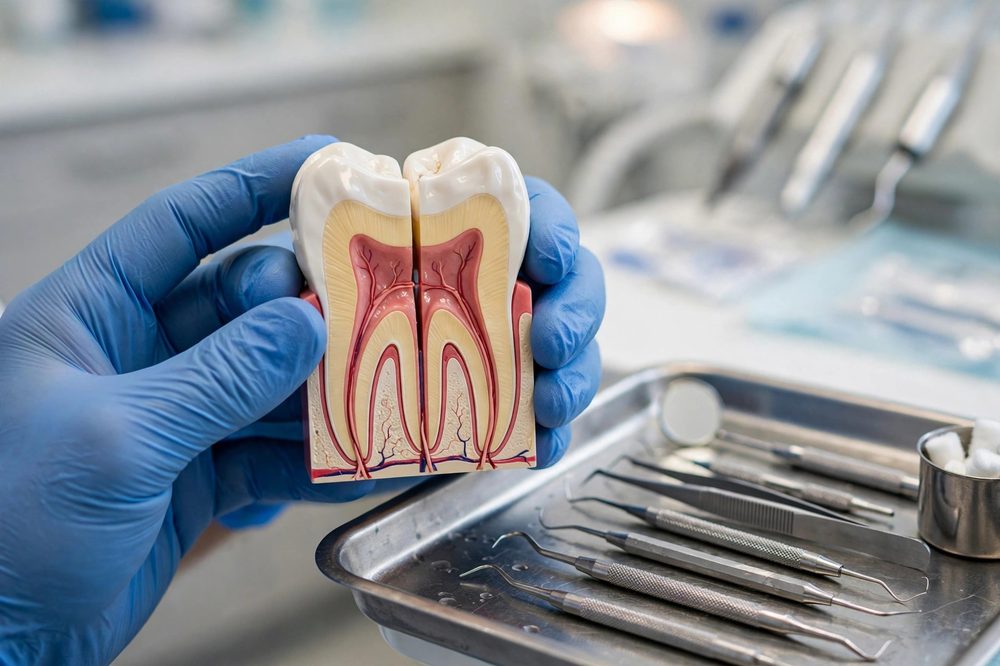
Inside every tooth is a soft centre called the pulp — nerves and blood vessels that helped the tooth develop. When deep decay, a crack, or an injury lets bacteria reach that pulp, it becomes inflamed or infected. That is the pain that throbs, wakes you at night, or flares when you bite or drink something hot. Antibiotics can calm an infection around a tooth for a while, but they cannot clean bacteria out of the inside of the tooth itself — the source stays.
Root canal treatment removes that source. The dentist numbs the tooth, opens a small access through the top, removes the infected or inflamed pulp, carefully cleans and disinfects the narrow canals inside the roots, then seals them and closes the tooth with a filling. Because a tooth that has had this treatment is more brittle than a living tooth, a back tooth that does the heavy chewing is usually protected afterwards with a crown. What remains is your own natural tooth — its root still anchored in the bone, still holding its place in your bite.
When a Tooth Can Usually Be Saved
Saving the tooth is usually a realistic option when:
- Enough healthy tooth structure remains above the gumline to hold a filling and a crown securely after the damaged part is removed.
- The crack, if there is one, stays above the root. A crack that stops in the crown of the tooth is a very different problem from one that runs down the root.
- The gums and bone around the tooth are reasonably healthy, so the tooth is stable and supported.
- The infection is contained — it has not destroyed so much of the surrounding bone that the tooth can no longer be supported.
- The tooth matters to your bite — which, honestly, most teeth do. A natural tooth keeps its neighbours from drifting and keeps chewing forces spread the way they were designed to be.
Keeping a natural tooth, when it can be restored properly, avoids the separate question of how to replace a missing one. That is why dentists generally start from “can this tooth be saved well?” rather than “should we just take it out?”
When Extraction Is the Honest Recommendation
There are also situations where trying to save the tooth would mean spending your time and money on a tooth with a poor outlook. Removal is usually the honest recommendation when:
- The tooth is cracked or split down through the root. A vertical root fracture cannot be sealed or repaired, and bacteria will keep leaking into the bone around it.
- Decay has destroyed the tooth below the gumline or into the root, leaving nothing sound for a crown to grip.
- Advanced gum disease has loosened the tooth — so much supporting bone is gone that even a perfect root canal would leave a tooth that cannot function. Gum problems of that kind belong to gum (periodontal) care, and the gum picture is always part of this decision.
- A previous root canal has failed and retreatment is not predictable — for example, a canal that cannot be cleaned again, or a post or instrument blocking it.
- The infection keeps returning despite treatment, or the tooth cannot be kept clean and healthy where it sits.
Hearing “this one needs to come out” is disappointing, but a dentist who levels with you about a hopeless tooth is protecting you from paying for treatment that was never likely to last. One exception to everything in this section: wisdom teeth follow their own rules — our guide to the signs wisdom teeth need to come out covers that decision separately.
What Happens After an Extraction — and Why Replacing the Tooth Matters
An extraction ends the problem of that tooth. It also starts a slower, quieter one: an empty space does not stay neutral. The teeth on either side gradually tip toward the gap, the tooth opposite it can drift down or up into the space, and your bite changes in ways that are hard to undo later. The bone that held the root also shrinks over time once the root is gone, which can make a replacement harder to fit the longer the space is left.
That is why the replacement conversation belongs in the same appointment as the extraction decision, not months later. Depending on the tooth and your situation, options can include a bridge, a denture, or an implant — each with its own requirements and limits, explained in our overview of tooth replacement and prosthodontic care. You do not have to decide everything on day one, but you should leave knowing what the realistic options are and what timing they need.
How the Decision Is Made at Your Assessment
At AF Dental, this decision is never made from the symptom story alone. The assessment looks at:
- An examination of the tooth and gums — how much sound tooth remains, whether a crack can be seen or felt, and how the gum and bone support the tooth.
- X-rays — showing the roots, the canals, any infection at the root tip, and the bone levels around the tooth.
- Restorability — the key question: after the decay or damage is removed, will there be enough healthy tooth left to rebuild on?
- Your overall health and the tooth’s role in your bite — a strategic back molar and a tooth under an existing denture are judged differently.
- Your priorities — some patients want every reasonable effort made to keep a natural tooth; others prefer the simpler path once the trade-offs are explained. Both are legitimate, and the honest pros and cons of each route are yours to weigh.
You can book that assessment through our book an appointment page or by calling (416) 792-6940. If your tooth is painful right now, say so when you call — AF Dental sees patients in pain during regular business hours (Mon, Wed, Thu, Fri and Sat 9–6, Sun 11–5; closed Tuesdays). We do not offer an after-hours service; if you develop spreading facial swelling, fever, or any trouble breathing or swallowing outside those hours, go to a hospital emergency department or call 911.
Myths Worth Retiring
“Root canals are agony.” This is the myth that refuses to die — and it is mostly a memory of dentistry from decades ago, and of the pain of the infected tooth itself, which is what brings people in. The appointment is done with the tooth numbed with local anesthetic, and the treatment removes the source of the pain rather than causing it. Soreness for a few days afterwards is normal; the honest picture is in the first FAQ below.
“Taking the tooth out is the cheap, final fix.” Removal ends that tooth’s problem, but if the gap then needs a bridge, denture or implant, the full path is rarely the simple one it first appears — and leaving the gap has its own costs in drifting teeth and changed bite. Compare the whole paths, not the first step of each.
“A root canal makes you sick.” Claims linking root canal treatment to illness elsewhere in the body circulate online, but they trace back to a study from a century ago that has not held up; modern endodontic care is a standard, well-studied treatment for removing infection from a tooth.
References
Ontario Dental Association — www.oda.ca · Canadian Dental Association — www.cda-adc.ca · Royal College of Dental Surgeons of Ontario — www.rcdso.org
Coverage information is from the Government of Canada’s Canadian Dental Care Plan pages (Canada.ca), linked in the questions below. CDCP rules can change; if anything here differs from Canada.ca, Canada.ca is correct.
Frequently Asked Questions About Root Canals and Extractions
- Is a root canal painful?
During the appointment, the tooth is frozen with local anesthetic before treatment begins, and the team checks that the area is numb before starting. What most people feel during the procedure is pressure and vibration rather than pain, and you can signal at any point if you feel something sharp. Afterwards, the tooth and the area around it are commonly sore for a few days — the tissues need time to settle after an infection — and that soreness is usually managed with pain relief taken as directed and eases day by day. Anyone who promises a completely sensation-free experience is overselling it; the honest description is numbed during, tender for a few days after, and steadily better — and the deep ache of the infected tooth itself is gone because its source has been removed.
- How will the dentist know if my tooth can be saved?
From two things together: the examination and the X-rays. The exam shows how much sound tooth structure remains above the gumline, whether there is a crack and how far it runs, and how firmly the gum and bone support the tooth. The X-ray shows the roots and canals, infection at the root tip, and bone levels. The deciding question is restorability — after everything damaged is removed, is there enough healthy tooth left to seal, rebuild and crown so it can carry chewing forces for years? If the answer is yes, saving the tooth is usually a sound plan. If the crack runs through the root or the remaining structure cannot hold a restoration, your dentist should show you that on the X-ray and explain why removal is the honest call.
- What happens if I have a tooth out and don’t replace it?
Sometimes, for a short time, nothing you can feel — which is exactly why gaps get left. Over months and years, though, the neighbouring teeth tend to tip toward the space and the opposing tooth can drift into it, changing your bite and creating new food traps and uneven wear. The bone under the gap also shrinks once the root is gone, so a replacement fitted later — especially an implant — can become more involved than one planned early. One missing back tooth with a stable bite is sometimes reasonably monitored rather than replaced, but that should be a deliberate decision made with your dentist, not a default. If a tooth does need to come out, ask about replacement options and timing at the same visit.
- Does the CDCP cover root canals and extractions?
Both root canal treatment and tooth removal are among the services the Canadian Dental Care Plan covers for eligible patients — see what the CDCP covers (Canada.ca). The conditions matter: your eligibility must be confirmed by the program first (no access to dental insurance, adjusted family net income under $90,000, taxes filed), your coverage must be active on the day of treatment, and the plan pays a percentage of its own established fees — so a co-payment or an additional charge is possible, and it is never automatically the full cost. Some services also need preauthorization. AF Dental direct-bills the CDCP, and our page on the Canadian Dental Care Plan (CDCP) at AF Dental explains how the plan works here.
- How many appointments does a root canal take?
It depends on the tooth and the state of the infection. Some teeth — typically a front tooth with a single canal and a settled infection — can be completed in one visit. A back molar has several canals, and a tooth with an active infection is sometimes cleaned and medicated at a first visit, then sealed at a second once symptoms have settled. After the root canal itself, a tooth that needs a crown needs a further appointment for that. Your dentist can give you the plan for your tooth at the assessment, once the X-ray shows the canals involved.
- Can a root canal fail? What happens then?
Yes, occasionally — no treatment succeeds every time, and it would not be honest to suggest otherwise. A treated tooth can become reinfected if a canal was too narrow or curved to clean fully, if new decay leaks in around an old filling or crown, or if the tooth cracks later. The first option is often retreatment: the old filling material is removed, the canals are cleaned again, and the tooth is resealed. If retreatment is not practical, or the tooth cannot be restored soundly afterwards, removal and replacement may be the better path. A crown on a back tooth, good cleaning around it, and regular check-ups all improve a treated tooth’s odds.
- What if I just leave the tooth and do nothing?
An infected tooth does not heal itself — the bacteria inside it have no blood supply reaching them, so the infection stays and usually spreads slowly into the bone at the root tip. The common pattern is flare-ups: pain and swelling that settle for a while, then return, each time destroying a little more bone. Occasionally the infection spreads more seriously, into the face or jaw — spreading swelling, fever, or difficulty opening your mouth, breathing or swallowing is a hospital emergency, not a wait-and-see problem. Leaving the tooth also narrows your options: the more bone an infection destroys, the harder the tooth is to save and the harder the site is to restore afterwards. If cost or anxiety is what is holding you back, say so at your assessment — there may be a staged plan, and knowing your real choices is better than quietly losing them.
- AF Dental offers no sedation — how is anxiety about the appointment handled?
Plainly: AF Dental does not offer sedation — no nitrous oxide and no oral sedation — so we will not pretend otherwise. What we do offer is a numb tooth, checked before we start; a team that explains each step before it happens; and your control of the pace — raise a hand and we stop. Many anxious patients find that the appointment they feared turns out to be quieter than the toothache that brought them in. If your anxiety is severe enough that you feel you cannot manage treatment awake, tell us at the assessment and we will discuss referral options honestly rather than pressuring you into the chair.