A back tooth with a large old filling cracks on a piece of crusty bread. A front tooth that had a root canal years ago starts to look grey and feel brittle. Or your dentist points at an X-ray and says the words nobody wants to hear: “This tooth needs a crown.” If you are researching dental crowns in Scarborough, the real question is usually simpler: does this tooth actually need a crown, or would a filling be enough — and what happens at the appointments if it does?
This guide answers that honestly: what a crown does, the situations where a crown is usually the right call, the situations where a filling is honestly enough, what the appointments involve, and how to look after a crowned tooth. If you want the service picture first, read about dental crowns and bridges at AF Dental in Scarborough, then come back for the decision guide.
On this page:
- What a Dental Crown Actually Does
- When a Tooth Usually Needs a Crown
- When a Filling Is Honestly Enough
- What the Crown Appointments Involve
- Crown Materials, in Plain Language
- Looking After a Crowned Tooth
- How Long Do Dental Crowns in Scarborough Last?
- Coverage, Honestly: CDCP, Insurance and Quotes
- References
- Frequently Asked Questions About Dental Crowns in Scarborough
What a Dental Crown Actually Does
A crown is a cap that covers the whole visible part of a tooth. A filling repairs a hole inside a tooth that still has strong walls around it. A crown is different: it wraps the tooth on all sides and holds it together, so biting forces are spread over the whole tooth instead of concentrating on a weakened edge or cusp. Think of it as a helmet for a tooth that can no longer protect itself.
That difference is why the crown-versus-filling decision matters. Putting a large filling into a tooth whose walls are thin can leave those walls flexing every time you chew, until one day a cusp breaks off — sometimes below the gumline, where the tooth may no longer be repairable. A crown, placed at the right time, is often what keeps a heavily repaired tooth in service.
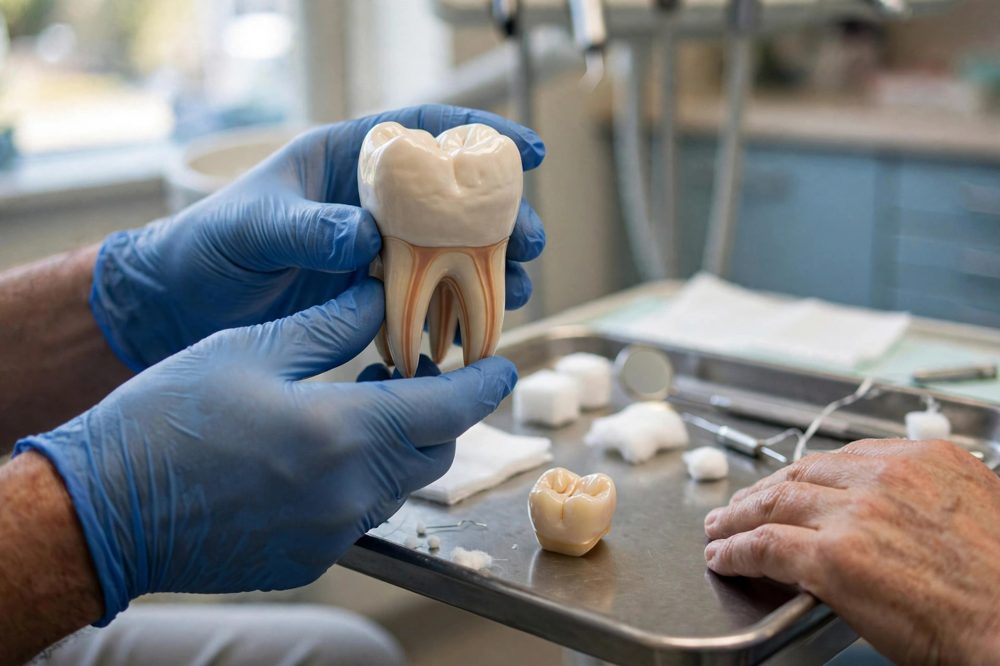
When a Tooth Usually Needs a Crown
Every case is decided from an examination and X-rays, but crowns are commonly recommended in situations like these:
- A large part of the tooth is filling already. When the filling is wider than the tooth structure left around it, the remaining walls are at real risk of fracture.
- A cusp or corner has broken. A broken cusp on a back tooth usually cannot be rebuilt predictably with a filling alone.
- After root canal treatment on a back tooth. A tooth that has had its pulp removed no longer has the same internal support, and back teeth take heavy chewing loads. A crown is commonly recommended to protect it — you can read more about the treatment itself on our root canal therapy page.
- A crack is present. Some cracked teeth can be stabilized by covering them fully, before the crack has a chance to travel deeper.
- The tooth is badly worn or misshapen and needs its shape and bite rebuilt, not just patched.
When a Filling Is Honestly Enough
A crown is not the answer to every cavity, and an honest guide should say so plainly. When decay is small or moderate and the walls of the tooth are thick and sound, a well-placed filling is the more conservative treatment — it keeps more of your natural tooth and can be completed in a single visit. You can read about that option on our dental fillings page. Crowning a tooth that only needs a filling means removing healthy tooth structure for no benefit, and that is not a trade worth making.
The grey zone is the medium-sized repair: big enough to worry about, small enough that a filling might hold. That is exactly what an assessment is for — the dentist weighs the size of the existing filling, any cracks, your bite, and whether you grind your teeth, and explains the reasoning either way.
What the Crown Appointments Involve
Crown treatment usually takes two visits. At the first visit, the tooth is numbed with local anaesthetic (freezing), any decay or failing old filling material is removed, and the tooth is shaped so the crown can fit over it. An impression or digital scan is taken and sent to the laboratory that will make the crown, and a temporary crown is placed to protect the tooth while you wait. At the second visit, the temporary is removed, the fit and bite of the finished crown are checked carefully, and the crown is cemented in place.
Between visits, the temporary crown deserves a little care: avoid very sticky foods on that side, and floss by sliding the floss out to the side rather than pulling it back up. If a temporary comes off, call the clinic — it should be dealt with promptly, because the prepared tooth underneath is not meant to stay uncovered.
AF Dental is open Monday, Wednesday, Thursday, Friday and Saturday from 9 a.m. to 6 p.m., and Sunday from 11 a.m. to 5 p.m.; the clinic is closed on Tuesdays. To book an assessment, call (416) 792-6940 or use the online booking page.
Crown Materials, in Plain Language
Crowns are made from a few families of materials, and the honest summary is that each trades strength, appearance and cost factors differently. All-ceramic and porcelain crowns match the colour of neighbouring teeth closely and are a common choice for front teeth. Porcelain fused to a metal base adds strength for back teeth. Full metal crowns are very durable and gentle on the opposing teeth, but their colour limits them to back teeth where they are rarely seen. Which material suits your tooth depends on where the tooth is, how heavy your bite is, and whether you clench or grind — your dentist will explain the recommendation for your case rather than defaulting to one material for everyone.
Looking After a Crowned Tooth
A crown protects a tooth; it does not make the tooth invincible. The edge where the crown meets the tooth — the margin — is still natural tooth structure, and it can still decay if plaque is left sitting there. Brush twice a day with fluoride toothpaste, clean between the teeth daily, and keep your regular check-up and cleaning rhythm so the margin is examined while any problem is still small. If you grind your teeth at night, ask about a night guard: grinding loads are a common reason crowns and the teeth under them fail early.
How Long Do Dental Crowns in Scarborough Last?
With ordinary care, a crown is a long-term restoration — it is often reported to last for many years, and systematic reviews of single crowns in the dental literature, including reviews by Sailer and colleagues and by Pjetursson and colleagues published in Clinical Oral Implants Research, report that most single crowns remain in service over five- and ten-year follow-up periods. Those figures describe groups of crowns in studies, not a promise for any one tooth: the outcome measured is whether the crown is still in place (survival), which is different from a crown needing no repair or attention at all (success). Your own result depends on the tooth underneath, your bite, grinding habits and home care, and no honest clinic guarantees a lifespan.
Coverage, Honestly: CDCP, Insurance and Quotes
There are no prices in this guide, on purpose: the right treatment for your tooth has to be decided from an examination first, and only then can anyone give you an exact written quote. Under the Canadian Dental Care Plan (CDCP), crowns may be covered for eligible patients, and crown coverage requires preauthorization — eligibility comes first, coverage follows the CDCP fee guide and is never presented as full coverage. AF Dental direct-bills the CDCP for eligible patients; you can read the full picture on our CDCP page. Private insurance plans vary widely in how they treat crowns, and the clinic can help you check your plan before treatment starts.
References
- Canadian Dental Association (CDA) — patient guidance on crowns, fillings and oral health.
- Ontario Dental Association (ODA) — patient resources on restorative dental care.
- Royal College of Dental Surgeons of Ontario (RCDSO) — the regulator for dentists in Ontario; its public register lets you verify any Ontario dentist.
- Government of Canada — Canadian Dental Care Plan — official eligibility and coverage information.
- Sailer I. et al. and Pjetursson B.E. et al., systematic reviews of single-crown survival, Clinical Oral Implants Research.
Frequently Asked Questions About Dental Crowns in Scarborough
Does getting a crown hurt?
The tooth is numbed with local anaesthetic (freezing) while it is prepared, so the appointment itself is usually comfortable in the ordinary sense that you should not feel the shaping work. Some tenderness or sensitivity in the days afterwards is common and usually settles. Tell the clinic if discomfort is getting worse instead of better — that is worth checking.
How many visits does a crown take?
Usually two: a preparation visit, where the tooth is shaped and a temporary crown is placed, and a fitting visit once the laboratory has made the finished crown. Your dentist will confirm the plan for your tooth at the assessment.
Can a filling be enough instead of a crown?
Yes, often. When decay is small or moderate and the remaining tooth walls are thick and sound, a filling is the more conservative choice and keeps more natural tooth. A crown is recommended when the remaining structure is too weak to hold a filling safely — the assessment and X-rays decide which side of that line your tooth is on.
Does a crowned tooth still need a root canal sometimes?
It can. A crown covers the outside of the tooth; the nerve inside can still become inflamed or infected, for example from deep decay under an old restoration. If that happens, root canal treatment can often be done through the crown, and the crown may be repairable afterwards — your dentist will explain the options if it arises.
Does the CDCP cover dental crowns?
Crowns may be covered for eligible CDCP patients, and they require preauthorization before treatment. Eligibility comes first, and coverage follows the CDCP fee guide rather than the clinic’s full fee, so it is never presented as complete coverage. The clinic can check your eligibility and submit the preauthorization.
What if my temporary crown falls off?
Call the clinic promptly. Keep the temporary if you have it, avoid chewing hard or sticky foods on that side, and do not try to glue it back yourself with household adhesives. The prepared tooth underneath should not stay uncovered for long.
Can a crown fall off or break?
Yes, though it is not common. Cement can wash out over years, and a crown can chip or the tooth under it can fracture, especially with heavy grinding. A crown that feels loose, moves when you chew, or comes off should be assessed promptly — sometimes it can simply be re-cemented if the tooth underneath is sound.
Will a crown look like my other teeth?
For front teeth, ceramic and porcelain crowns are shade-matched to your neighbouring teeth and are designed to blend in. No restoration is identical to natural enamel in every light, but a well-made front crown is not usually noticeable in ordinary conversation. Your dentist will discuss material choices and appearance honestly at the assessment.
If a tooth has cracked, a large filling has failed, or you have been told a tooth may need a crown, an assessment is the honest next step. Call AF Dental in Scarborough at (416) 792-6940 — Monday, Wednesday, Thursday, Friday and Saturday 9–6, Sunday 11–5, closed Tuesdays.