
Every drugstore in Scarborough has a shelf of whitening strips, pens and LED kits promising a brighter smile by the weekend. And every dental office offers professional whitening that costs more of your time and money. So which one is actually right for your teeth? If you are researching teeth whitening in Scarborough, the honest answer is that the two options do different jobs — and the wrong choice is usually not dangerous, just disappointing, unless there is an untreated problem hiding under the stain.
This guide compares them side by side: how whitening works, what store-bought products can realistically do, what professional treatment adds, the stains neither option can fix, and who should be assessed before whitening anything. If you want the service picture first, read about professional whitening treatment at AF Dental in Scarborough, then come back for the comparison.
On this page:
- How Teeth Whitening Actually Works
- Teeth Whitening in Scarborough: Professional vs Store-Bought, Side by Side
- What Over-the-Counter Strips and Kits Can Realistically Do
- What Professional Whitening Adds
- The Stains Whitening Cannot Fix
- Sensitivity: What to Expect, Honestly
- Who Should Not Whiten Without an Assessment
- How to Choose
- Coverage, Honestly: CDCP, Insurance and Quotes
- References
- Frequently Asked Questions About Teeth Whitening in Scarborough
How Teeth Whitening Actually Works
Almost all whitening products — drugstore and professional alike — use peroxide-based gels. The peroxide breaks down large, dark stain molecules into smaller, lighter ones, which makes the tooth look whiter. The Canadian Dental Association (CDA) notes that whitening works on the enamel surface and, with stronger gels used under supervision, can reach stains that sit a little deeper. What differs between products is the strength of the gel, how evenly it stays in contact with your teeth, how long it is used, and whether anyone checked your teeth before you started.
Two limits apply to every product on the market. First, whitening only works on natural tooth structure — crowns, veneers, bonding and white fillings do not change colour. Second, whitening cannot change the underlying natural shade of your teeth beyond what your enamel allows, which is why results vary from person to person and why no honest provider promises a specific shade.
Teeth Whitening in Scarborough: Professional vs Store-Bought, Side by Side
| Store-bought strips and kits | Professional whitening | |
|---|---|---|
| What it is / how it works | Low-strength peroxide strips, pens or one-size trays you apply yourself at home, following the box instructions. | Peroxide gel applied in the dental office, or in custom-made trays you take home, after an examination of your teeth and gums. |
| Typical lifespan of the result | Results fade gradually as new stains build up; how long they last depends mainly on coffee, tea, red wine, smoking and home care, as the CDA’s whitening guidance describes — there is no fixed timeline for any patient. | The same fading process applies. Professional treatment often starts from a more even result, and a maintenance plan (and custom trays for touch-ups) can make upkeep simpler, but no result is permanent. |
| Maintenance and care | Repeat courses as directed on the box; avoid staining foods and drinks during and shortly after treatment; keep up brushing and flossing. | Touch-ups with your custom trays as your dentist advises; the same stain-avoidance and home-care habits; regular check-ups so new staining and decay are caught early. |
| Effect on neighbouring teeth and restorations | Strips can miss curved or crowded areas, so neighbouring teeth may whiten unevenly. Crowns, veneers and fillings do not whiten at all, which can make a treated smile look patchy. | The dentist checks existing restorations first and plans around them, so colour differences are discussed before treatment — and replacing a mismatched restoration afterwards is planned openly, not discovered by surprise. |
| Who it suits and who it does not | Suits patients with healthy teeth and gums and mild surface staining who want a modest change. Does not suit anyone with untreated decay, gum disease, or heavy intrinsic (deep) staining. | Suits patients who want a more even, supervised result, have restorations to plan around, or have tried strips with little effect. Does not suit teeth whose discolouration comes from decay, a dying nerve, or certain medications — those need treatment, not whitening. |
| Number of visits and treatment timeline | No visits; a course usually runs over days to a few weeks of home use, depending on the product. | An assessment visit first. In-office whitening is then completed in one or a small number of appointments; take-home custom trays are used over a period your dentist sets for your case. |
| CDCP coverage | Not applicable — retail products are bought directly. | Teeth whitening is a cosmetic service and is not covered by the Canadian Dental Care Plan (CDCP). Eligibility and coverage for other dental care are explained on our CDCP page and at Canada.ca. |
One row is deliberately missing from that table: price. Whitening products and treatments vary too much in strength and scope for a published figure to mean anything, and the factors that affect cost — the type of staining, whether restorations need replacing to match, and whether decay or gum problems must be treated first — can only be assessed in person. That is why cost questions are answered with an assessment and an exact written quote, never a number on a webpage.
What Over-the-Counter Strips and Kits Can Realistically Do
Store-bought products are reasonable at one job: lifting recent surface stain — the film from coffee, tea, cola, red wine and tobacco that sits on the enamel. Used exactly as directed, on healthy teeth, they can produce a modest, gradual lightening. Their limits are built in: the gel is weaker, one-size strips do not hug crowded or rotated teeth evenly, and nobody has examined your mouth first. If a cavity, a cracked filling or inflamed gums are present, whitening gel can irritate them, and the box cannot tell you that.
What Professional Whitening Adds
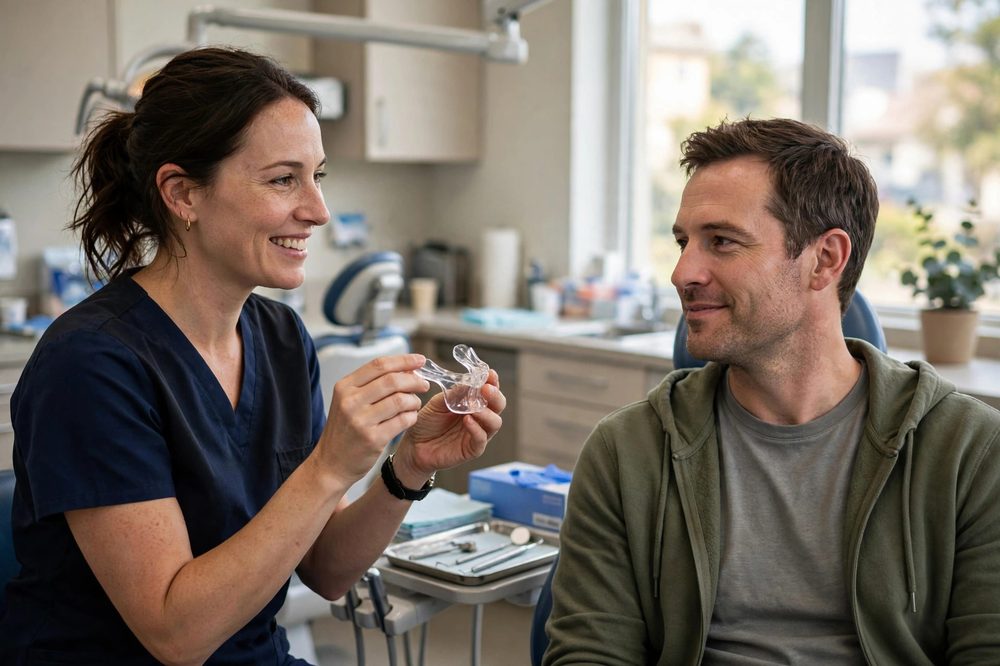
Professional whitening is not magic gel — it is the same chemistry with four things added. An assessment first, so decay, gum disease and failing restorations are found before gel touches your teeth. Stronger gel used safely, with your gums and lips protected during in-office treatment. Custom trays for take-home treatment, so gel contacts every tooth evenly instead of pooling on the flat front surfaces. And a plan for restorations, because your dentist can see which crowns or fillings will stay their old colour and talk through sequencing before you spend anything. You can read more about the treatment itself on our page for professional whitening treatment at AF Dental in Scarborough.
The Stains Whitening Cannot Fix
Some discolouration is not surface stain at all. A tooth that has died after an injury turns grey from the inside. Certain antibiotics taken in childhood, excess fluoride during tooth development, and thinning enamel that lets the darker dentin show through all change colour in ways peroxide cannot reverse. Existing crowns, veneers and fillings stay exactly the colour they were made. For these cases the honest conversation is about options such as porcelain veneers or replacing a mismatched restoration — which is a treatment discussion, not a whitening one. The wider cosmetic picture is on our cosmetic dentistry page.
Sensitivity: What to Expect, Honestly
Temporary sensitivity is the most common side effect of whitening, with any product. Peroxide can pass through enamel and briefly irritate the nerve, causing zingy reactions to cold for a day or two. It usually settles on its own. Using more gel, more often, than directed does not whiten faster — it mostly increases sensitivity and gum irritation. If sensitivity is severe or does not settle, stop and have the tooth examined: persistent pain can be a sign of decay or a crack that whitening happened to reveal.
Who Should Not Whiten Without an Assessment
Have your teeth examined first if you have untreated decay, bleeding or swollen gums, a broken or leaking filling, teeth that are already very sensitive, or if you are pregnant — whitening is elective, and elective treatment can wait until the underlying issue is treated. Children and young teens should not whiten without dental advice, because their teeth and gums are still developing. None of this is a sales pitch: in many of these cases the right first step is a routine examination, and whitening becomes a short conversation afterwards.
How to Choose
Choose store-bought strips if your teeth and gums are healthy, your staining is mild and recent, you have no crowns or fillings on your front teeth, and a modest change is enough. Choose professional whitening if strips barely changed anything, your teeth are crowded or unevenly stained, you have visible restorations that must be planned around, or you simply want someone to check your teeth first and supervise the process. And choose neither, yet if anything in your mouth hurts, bleeds or looks broken — treat that first. If you would like an assessment, you can book an appointment or call AF Dental at (416) 792-6940. Our hours are Monday, Wednesday, Thursday, Friday and Saturday 9 a.m.–6 p.m., Sunday 11 a.m.–5 p.m., and closed Tuesdays.
Coverage, Honestly: CDCP, Insurance and Quotes
Whitening is cosmetic, so it is not covered by the CDCP and is rarely covered by private dental insurance. That is worth knowing before you plan around it. Other care you may need first — examinations, cleanings, fillings — may be covered for eligible CDCP patients; AF Dental direct-bills the CDCP, and the details live on our CDCP page rather than here, because eligibility is individual. For whitening itself, the clinic provides an exact written quote after an assessment, so you can decide with the full picture in front of you.
References
- Canadian Dental Association — guidance on teeth whitening, oral health and dental care in Canada.
- Ontario Dental Association — patient information on cosmetic dental treatments.
- Canada.ca — Canadian Dental Care Plan — official eligibility and coverage information.
- Royal College of Dental Surgeons of Ontario — the register to verify any Ontario dentist.
Frequently Asked Questions About Teeth Whitening in Scarborough
Will whitening damage my enamel?
Used as directed, peroxide whitening products have not been shown to damage enamel — that is the position reflected in Canadian Dental Association guidance. Problems come from misuse: using products too often, leaving gel on far longer than directed, or whitening teeth that have untreated decay, where gel can reach the nerve. An assessment first removes most of that risk.
Why did whitening work for my friend but barely change my teeth?
Because the stain was probably different. Surface stain from food and drink lifts relatively easily; discolouration from inside the tooth, from medications, or from thinning enamel responds much less. Your natural starting shade also sets the ceiling for how light your teeth can go, and that differs between people.
How long do whitening results last?
There is no honest fixed answer, because it depends on what caused the staining and what you keep doing. Coffee, tea, red wine and smoking restain teeth; good home care and regular professional cleanings slow that down. Results fade gradually rather than disappearing overnight, and professional treatment can be maintained with planned touch-ups.
Can I whiten if I have a crown or filling on a front tooth?
You can whiten your natural teeth, but the crown or filling will not change colour — so the restoration may end up visibly darker than the teeth around it. This is one of the most common reasons to be assessed first: sometimes the plan is to whiten first, let the shade settle, and then replace the restoration to match.
Do whitening strips work as well as professional whitening?
For mild surface stain on healthy, fairly straight teeth, strips can give a modest improvement. Professional whitening uses stronger gel under supervision, custom trays for even contact, and an examination beforehand — which generally produces a more even result and catches problems strips cannot. Neither can change restorations or deep internal discolouration.
Is teeth whitening covered by the CDCP or insurance?
No. Whitening is a cosmetic service and is not covered by the Canadian Dental Care Plan; most private dental plans exclude it as well. Care you may need before whitening — such as examinations or fillings — can be covered for eligible patients, and the clinic will explain your individual situation at your assessment.
Why do my teeth feel sensitive after whitening?
Peroxide gel can temporarily irritate the nerve inside the tooth, which makes it react to cold for a short time. This usually settles within a day or two. Avoid very hot and cold foods meanwhile, do not apply extra gel to compensate, and if sensitivity is strong or lasts longer, have the tooth examined.
Should I get a cleaning before whitening?
Usually, yes — and it is part of why an assessment comes first. Whitening gel works on clean enamel; plaque and tartar block it and cause patchy results. A professional cleaning removes that barrier and gives the dentist a clear look at your teeth and gums before any cosmetic treatment.